
Earn a global finance degree offering flexible career options.
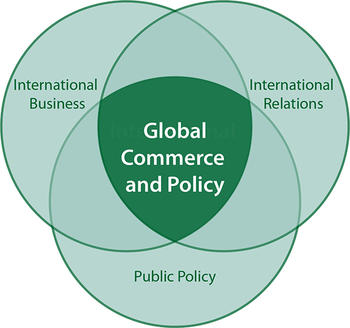
The Global Commerce and Policy program combines the best of both a traditional international affairs degree and a business degree for intellectually curious, driven students. You will graduate ready to take on a wide range of leadership positions.
Program professors have held positions at the World Bank, the U.S. International Trade Commission, the United Nations Development Program, the U.S. Treasury, the European Commission, the U.S. Office of Technology Assessment, and the U.S. Environmental Protection Agency. You will be treated as a future peer by our expert faculty, a group of renowned scholars and practitioners who focus their teaching and research on a diverse range of topics in both domestic and international contexts.
Effective spring 2022, the International Commerce and Policy program has been renamed the Global Commerce and Policy program.
Email us: schar@gmu.edu
Call: 703-993-8099
Request Program Information

“I felt intuitively that a standard MBA or International Affairs program would not give me the answers I was looking for—I felt that I needed a broader, more multidimensional program. It enhanced my ability to think laterally in the design and execution of complex multinational policies, strategies, and programs.”
Regional Integration - African Development Bank Group
Master of Global Commerce and Policy '06
Skills You'll Gain
- To understand the basic principles of international relations, global political economy, and comparative politics
- To be able to deploy the micro- and macroeconomic analytical techniques to policy analysis in global trade, finance, and development
- To understand the institutional structures of global trade, finance, and development
- To understand, access and make use of global trade, financial, and development data
A Degree That Works With Your Schedule
You can earn this degree:
- On-campus
- Entirely online in an asynchronous format
- Through a combination of on-campus and online classes
- Part-time or full-time
Classes are offered in the evening to accommodate working students.
D.C. and Maryland Pricing Discount
Master's or certificate students who reside in Washington, D.C., and Maryland can qualify for a tuition rate is equivalent to the in-state rate! This new policy applies to Schar School students who begin their degree in fall 2023 or later.

Where Our Recent Graduates Work
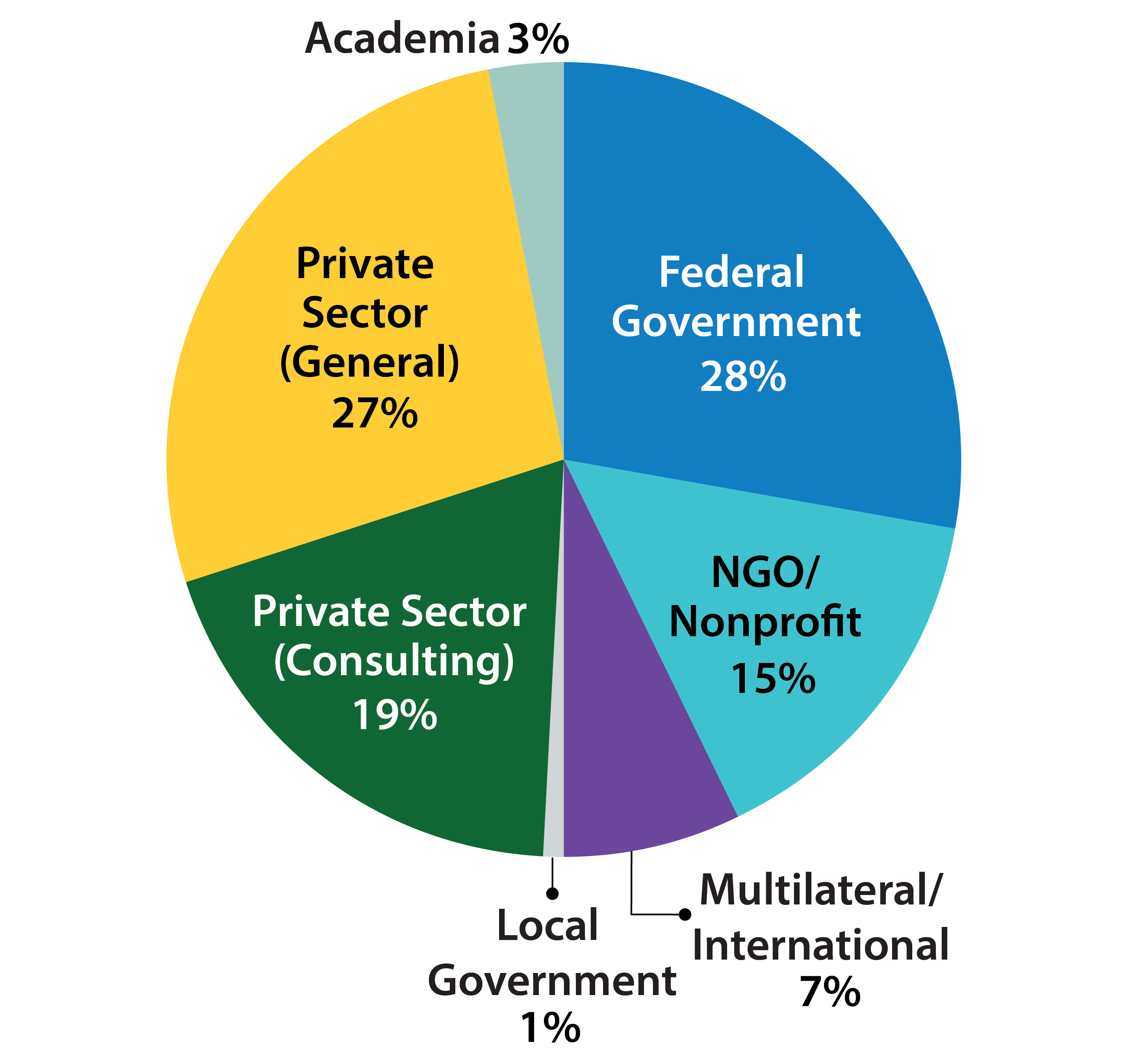
Data gathered from recent graduates from 2017-21
Top Employers of Recent Graduates
- BAE Systems Inc.
- Bloomberg
- Booz Allen Hamilton
- Fannie Mae
- Honeywell
- Inter-American Development Bank
- International Monetary Fund
- Northrop Grumman
- The World Bank
- U.S. Department of Commerce
- U.S. Department of Homeland Security
- U.S. Department of State
- U.S. Department of the Treasury
The median salary of 2020-21 program graduates surveyed after graduation was $86,000.

“I chose the Schar School because I always wanted to mix public policy and business, and the international commerce and policy master’s program is the only program that does both. I love how you don’t only look at the economic background but also the political background of a country.”
Consultant, The World Bank
Master of Global Commerce and Policy '20
The Master of Arts in Global Commerce and Policy program requires 12 courses (36 total credits), including seven core courses:
- Global Political Economy
- Technology, Culture, and Commerce
- Microeconomics and Trade Policy
- Macroeconomic Policy in the Global Economy
- Global Trade Relations
- Global Financial Crises and Institutions
- Data Analysis for Global Political Economy or Introductory Data Analysis for Policy and Government
Interested in a graduate certificate instead?
Our graduate certificates require just five courses (15 credits) that can be applied to a master's if you choose to continue on.
“In today's world, it is critical for all participants in global markets to understand the multifaceted environment in which they work. This program is for those who are passionate about the intersection of international relations, business, and public policy.”

Practitioner Faculty
With the Schar School's prime location in the Washington, D.C. area, students gain access to leading practitioners who are internationally recognized for their scholarship and advisory roles in the public and private sectors. These faculty bring real-world experience to the classroom, providing you with the mentorship and skillsets needed to advance in your career.
“I saw the [global] commerce and policy program and thought it was so cool because it was basically a mixture of international relations degrees and business—how the two intersect. I think that’s really valuable in the world we live in today.”
Global Email Marketing Manager, Microsoft
Master of Global Commerce and Policy '18