
As new technologies reshape our lives and culture, George Mason University aims to be an ambassador of thoughtful collaboration between human and machine. The Grand Challenge Initiative solution of "driving responsible digital innovation and sustainable infrastructure" calls on faculty, researchers, and students to consider technology holistically and in context to help shape a digital future that is as ethical as it is advanced.
This year, both new and established summer camps across George Mason's Virginia campuses let high school students and undergraduates get hands-on experience with emerging technologies while demonstrating the importance of responsible use, paving the path for the next generation of innovators and inventors.
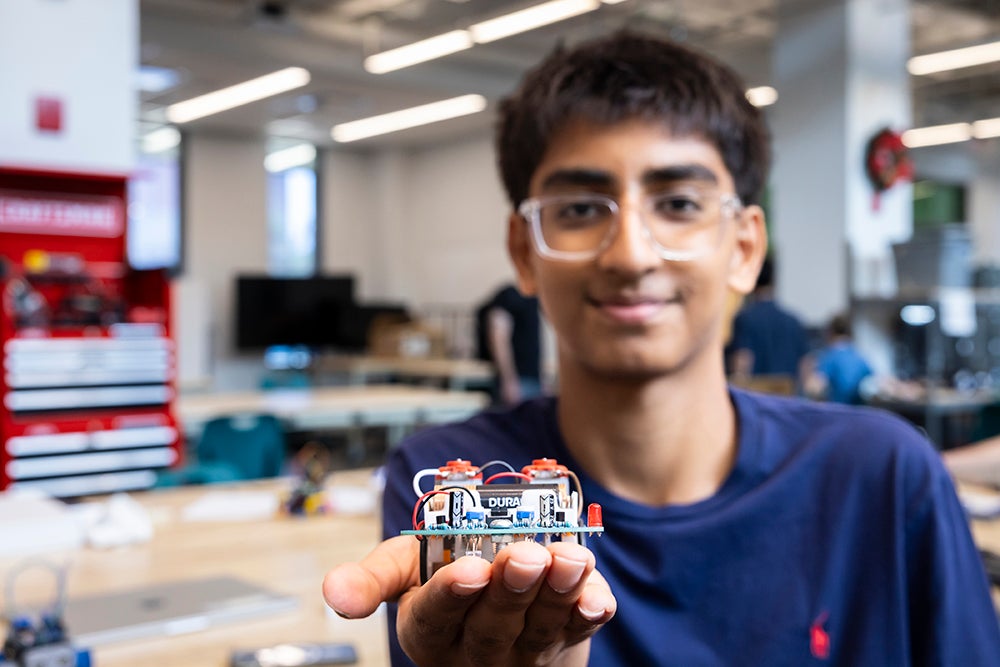
MIX Maker Academy
On the Fairfax Campus, the Mason Innovation Exchange (MIX) is a central hub for innovation, exploration, and creativity at George Mason, hosting a makerspace, media lab, and entrepreneurship incubator. From developing bio-inspired blimps to helping students jumpstart their start-ups, the MIX is a campus leader of responsible digital innovation and sustainable infrastructure.
This year, the MIX launched its inaugural summer camp program, introducing high school students to interdisciplinary innovation and principles of STEAM (Science, Technology, Engineering, Art, and Mathematics) by building an integrated design project from the ground up.
During the two-week program, campers learn about the professional tools and technologies used in engineering, design, robotics, and digital media production, such as 3D printing, sewing and embroidery, woodshop, laser cutting, and studio lighting and camera work. By the end of the program, students have multiple small fabrication projects, integrated design projects, and a multimedia blog portfolio demonstrating their work and the skills developed during camp.
"We guide and encourage students to envision project ideas that would have a positive impact on the world, benefiting people, communities, and our environment," said Max B. Kazemzadeh, MIX makerspace and events manager.
MARC Robotics Academy
Another new opportunity for students this summer came from the College of Engineering and Computing's Mason Autonomy and Robotics Center (MARC) Robotics Academy: an ongoing internship program for high school and undergraduates to work alongside George Mason's robotics faculty and graduate students.
"The program is designed to give students firsthand experience with the research process while building technical and professional skills," said Jesse Kirkpatrick, associate research professor and codirector of MARC. "They get hands-on experience in technologies that are shaping the future."
Academy interns support cutting-edge research through hardware platform development, data collection and analysis, testing and coding machine learning, and more. This summer, for example, students who worked with Missy Cummings, professor and codirector of MARC, and Kirkpatrick built a data set to investigate how well large language models can search, retrieve, and identify relevant information within large collections of Freedom of Information Act documents. A team with Cameron Nowzari, associate professor in the Department of Electrical and Computer Engineering, helped research the design, development, and deployment of robot swarms.
"By developing both technical expertise and an appreciation for responsible innovation, the academy helps prepare future leaders who can contribute to secure, trustworthy, and sustainable technological solutions," said Kirkpatrick.
ACCESS Academy AI summer camp
At Mason Square, the second annual ACCESS Academy AI summer camp also prepared students for the future of artificial intelligence (AI) and robotics.
Beginner session campers learned to program micro:bit robots to follow a track through Microsoft MakeCode. Advanced sessions campers spent their week learning Python programming and building functional code to make XRP robots autonomously traverse a maze. As these high school students develop machine-learning skills, faculty, staff, and George Mason students lead conversations about AI's real-world applications and regulations.
“We hope that the participants of our camp see the connection between the concepts of coding and the practical implementation of physical AI in real-time applications," said Roberto Pamas, ACCESS Academy director.
ACCESS Academy's AI summer camp exposes students to problem-based learning through real-world challenges as students develop skills in tech tools that boost their creativity, critical thinking, and collaboration. The camp also gives students a taste of what the College of Education and Human Development's (CEHD) ACCESS Academy—a no-cost alternative educational pathway that expands access to information technology education and skills for any rising 9th-12th grade student in the Commonwealth of Virginia—has to offer.
"ACCESS AI summer camp is demonstrating firsthand how new technologies and learning are shaping education and the world around us," said Christy Hudson of CEHD's Office of Strategic Enrollment. "We are helping shape the digital future."
In This Story
Related news
- August 21, 2026
- August 17, 2026
- August 12, 2026
- August 10, 2026
- July 17, 2026